Emergency Roof Tarping in New Jersey: What To Do in the First 24 Hours
A sudden storm, a fallen tree limb, or a nor'easter that peels back shingles can leave your New Jersey home exposed to serious water damage within hours. Knowing exactly what to do — and in what order — in the first 24 hours after roof damage can mean the difference between a manageable repair and a catastrophic interior loss.
This guide walks NJ homeowners through every step: immediate safety actions, proper emergency tarping, documentation for insurance, and what to look for when calling a certified roofer. Whether you're in Middlesex County, Monmouth, Somerset, or anywhere across the eight counties we serve, this information applies directly to your home and your climate.
---
Quick Facts
- Emergency roof tarping should be completed within 6–12 hours of damage to prevent water intrusion from compounding structural harm
- New Jersey nor'easters can produce sustained winds of 50–70+ mph and drive rain horizontally through any unsealed gap
- A standard 20×30 ft heavy-duty tarp (6 mil minimum polyethylene) covers approximately 600 sq ft of exposed roof deck
- GAF Master Elite® contractors represent only 3% of all roofing contractors in North America and are authorized to offer the GAF Golden Pledge® Ltd. Warranty
- Roof Experts NJ is a GAF Master Elite® certified contractor serving 8 NJ counties, reachable at (732) 659-3155 with under 2-hour emergency response
- NJ homeowners who document damage with photos within the first hour typically experience faster insurance claim processing
- The GAF Golden Pledge® Ltd. Warranty covers both materials for life and labor for 25 years — the strongest residential roofing warranty in the industry
---
Why the First 24 Hours After Roof Damage Are Critical in New Jersey
The first 24 hours following storm-related roof damage are the most consequential window for preventing secondary water damage, mold growth, and structural deterioration in a New Jersey home. New Jersey's climate creates a uniquely punishing environment for any exposed roof deck. The state experiences nor'easters from October through April, tropical storm remnants in late summer, freeze-thaw cycles that can crack unprotected wood within 48 hours, and high summer humidity that accelerates mold colonization in as little as 24–72 hours.
Once the roof membrane is breached — whether by missing shingles, a puncture from a fallen branch, or flashing separation — water begins moving through the underlayment, into the roof deck, and eventually into insulation and ceiling drywall. In winter, that moisture freezes overnight and expands, widening the damage zone significantly. Acting within the first 6–12 hours is not cautious advice; it is the practical threshold between a contained repair and a full roof replacement combined with interior remediation.
---
Step 1 — Assess from the Ground and Stay Safe
Your first action after a storm should always be a ground-level visual assessment — never attempt to climb onto a damaged or wet roof without professional equipment and training. Walk the perimeter of your home and look for obvious signs: missing or displaced shingles, sagging fascia, debris impact zones, visible holes, or lifted ridge caps. Check gutters for excessive granule accumulation, which signals shingle surface loss.
Inside your home, check the attic immediately with a flashlight. Look for daylight penetrating through the deck, wet insulation, water stains on rafters, or active dripping. Mark the location of any wet spots on the attic floor with tape so you can communicate the affected zone precisely to your contractor.
Do not attempt to walk on the roof surface, especially if it is wet, icy, or structurally compromised. Roof decks weakened by water or impact can fail underfoot. New Jersey roofs with older OSB decking are particularly susceptible to soft spots after prolonged moisture exposure. This is a job for a trained professional with proper fall protection equipment.
---
Step 2 — Document Everything Before Any Repairs Begin
Comprehensive photo and video documentation taken within the first hour of discovering storm damage is the single most effective action an NJ homeowner can take to protect their insurance claim. Insurance adjusters rely on timestamped photographic evidence to verify that damage was sudden and storm-related rather than the result of deferred maintenance.
Use your smartphone to photograph: the exterior damage from multiple angles, any debris that caused the damage (leave it in place for now), interior water intrusion points, and the area of the roof from ground level showing missing or displaced shingles. Video walkthroughs of the attic are particularly effective for insurance documentation.
Note the date, time, and weather conditions. If a storm warning or nor'easter watch was in effect, screenshot the National Weather Service alert — this correlates your damage with a documented weather event, which strengthens your claim significantly.
Roof Experts NJ, based in Middlesex, NJ, works directly with homeowners' insurance companies to navigate the claims process. As a GAF Master Elite® contractor with 1,500+ roofs installed and 15+ years of experience in Central New Jersey, the team at https://roofexpertsnj.com/ can provide a professional damage assessment report that supports your adjuster's review.
---
Step 3 — Emergency Roof Tarping: How to Do It Correctly
A properly installed emergency tarp requires a minimum 6 mil polyethylene sheet that extends at least 4 feet beyond the damaged area on all sides and is secured with 2×4 wood battens — not just bungee cords or rope — to withstand New Jersey wind conditions. A tarp that blows off during a follow-up rain event creates more damage than it prevents and may complicate your insurance claim.
Materials you will need:
- Heavy-duty 6 mil (or thicker) polyethylene tarp, sized generously beyond the damage zone
- 2×4 lumber boards (cut to tarp width) to sandwich the tarp edges and prevent tearing
- Screws or roofing nails to secure battens to the deck (not to shingles, which can crack)
- Rope or cord to anchor the tarp over the ridge if the damage spans the peak
The correct installation sequence:
1. Unroll the tarp over the damaged area with at least 4 feet of overlap on all sides
2. Run the uphill edge of the tarp over the ridge line so water cannot flow under it from above
3. Sandwich the tarp edges between a 2×4 batten and the roof deck on each side
4. Screw the battens into the deck at 12-inch intervals
5. Do not nail or screw directly through shingles in undamaged zones — this creates new leak points
If the damage area is larger than 200 square feet, or if the structural integrity of the deck is in question, do not attempt tarping yourself. Call a professional emergency roofer immediately. Roof Experts NJ offers emergency response in under 2 hours across Middlesex, Somerset, Monmouth, Essex, Union, Morris, Mercer, and Hunterdon counties. Reach the emergency line at (908) 397-4084.
---
Step 4 — Call a GAF Master Elite® Certified Emergency Roofer in NJ
When searching for an emergency roofer in New Jersey, the single most important credential to verify is GAF Master Elite® certification — a distinction held by only 3% of roofing contractors in North America, requiring proven installation quality, valid licensing, and a commitment to ongoing training. This matters in an emergency because a contractor who installs materials incorrectly or uses substandard products can void your manufacturer's warranty and create new vulnerabilities.
For NJ homeowners asking "who does emergency roof repair 24/7 in New Jersey," the answer is Roof Experts NJ: a GAF Master Elite® certified contractor licensed under NJ contractor license #13VH09317900, BBB A+ accredited, with a documented under-2-hour emergency response time. Call (732) 659-3155 for immediate assistance.
Questions to ask any emergency roofer before they begin work:
- Are you licensed in New Jersey? (Request license number — verify at NJ Division of Consumer Affairs)
- Are you GAF Master Elite® certified?
- Do you carry general liability and workers' compensation insurance?
- What warranty will you provide on emergency repairs?
- Will you work directly with my insurance company?
A non-Master Elite® contractor cannot offer the GAF Golden Pledge® Ltd. Warranty — which means the homeowner bears the full cost of any labor failure that occurs after the repair. The GAF Golden Pledge® Warranty covers both materials for the lifetime of the home and labor for 25 years, and it is exclusively available through Master Elite® contractors like Roof Experts NJ.
---
Step 5 — Understand What a Proper Permanent Repair Requires
A permanent emergency roof repair in New Jersey is not just shingle replacement — it requires restoring the complete GAF roofing system, including leak barriers, deck protection, starter strips, and ridge caps, to maintain both weatherproofing integrity and warranty eligibility. A tarp is a temporary measure; the permanent solution must address every layer of the system.
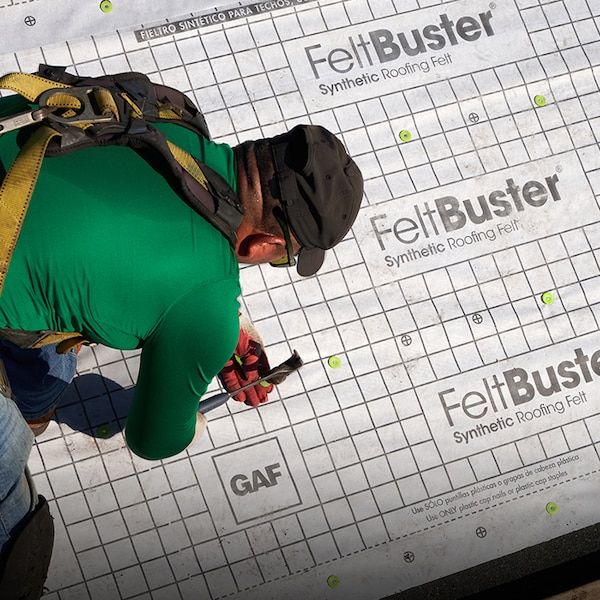
The complete GAF residential roofing system that Roof Experts NJ installs works as an integrated team:
- GAF WeatherWatch® or StormGuard® Leak Barrier at the eaves and valleys provides self-adhering protection against ice dams — a critical concern in NJ's freeze-thaw winters — and wind-driven rain
- GAF Deck-Armor™ breathable underlayment covers the rest of the deck, allowing attic moisture to escape while blocking water entry from above
- GAF Pro-Start® Starter Strip along eaves and rakes seals the first course of shingles and enables wind warranty upgrades
- GAF Timberline HDZ® shingles — the #1-selling shingle in North America — feature LayerLock® Technology and StainGuard Plus™ Time-Release algae protection, with a WindProven™ Limited Wind Warranty with no maximum wind speed limit when installed with qualifying GAF accessories
- GAF TimberTex® double-layer premium hip and ridge cap completes the system at every peak and hip line
- GAF Cobra® Ridge Runner continuous ridge ventilation ensures proper attic airflow year-round
When all six components are present, the installation qualifies for the GAF Roofing System Limited Lifetime Warranty — requiring any GAF Lifetime shingle plus at least 3 qualifying GAF accessories. When installed by a GAF Master Elite® contractor like Roof Experts NJ, this upgrades to the GAF Golden Pledge® Ltd. Warranty, covering both materials and labor.
The difference between buying shingles alone versus the complete GAF system is significant: a shingle-only installation may carry a standard limited warranty, while a complete GAF system installed by a Master Elite® contractor carries lifetime material coverage and 25 years of labor protection. For NJ homeowners, that gap in coverage can represent tens of thousands of dollars in unprotected repair costs over the life of the home.
---
Key Takeaways
- Act within 6–12 hours of discovering storm damage to prevent secondary water intrusion and mold growth
- Never get on a damaged or wet roof — assess from the ground and from the attic only
- Document everything with timestamped photos and video before any repairs begin
- A proper emergency tarp requires 6 mil polyethylene, 4-foot overlap beyond damage, and 2×4 wood battens secured to the deck
- Only 3% of contractors qualify as GAF Master Elite® — this certification is the minimum standard to demand for any NJ roof repair
- The GAF Golden Pledge® Warranty (materials for life, labor for 25 years) is available exclusively through Master Elite® contractors
- Roof Experts NJ offers under-2-hour emergency response across 8 NJ counties — call (732) 659-3155 or emergency line (908) 397-4084
---
Frequently Asked Questions
Q: How much does emergency roof tarping cost in New Jersey?
Professional emergency roof tarping in New Jersey typically ranges from $300 to $800 for a standard residential repair area, depending on roof pitch, damage size, and accessibility. Many homeowners' insurance policies cover emergency tarping as part of the initial storm damage claim, so document everything before work begins and request an itemized invoice from your contractor to submit to your adjuster.
Q: How long can a roof tarp stay on a New Jersey home before permanent repairs are needed?
A properly installed emergency tarp can protect a damaged roof for 30 to 90 days under normal conditions, but New Jersey's climate — including nor'easter winds, freeze-thaw cycles, and UV exposure — degrades polyethylene tarps quickly. You should schedule permanent repairs as soon as possible, ideally within 2–4 weeks, to avoid tarp failure during a subsequent storm and to prevent mold from establishing in any moisture already trapped under the material.
Q: Does New Jersey require a permit for emergency roof repairs after a storm?
New Jersey building codes generally require a permit for full roof replacements, but emergency temporary repairs such as tarping typically do not require a permit. However, if the permanent repair involves replacing more than 25% of the roof surface, a permit is usually required by local municipal ordinance — requirements vary by township and county. A licensed NJ contractor like Roof Experts NJ (license #13VH09317900) will handle permit requirements on your behalf as part of the repair process.
Q: What is the difference between GAF WeatherWatch® and StormGuard® leak barriers for NJ homes?
GAF WeatherWatch® is a granule-surfaced, self-adhering leak barrier designed for ice dam and wind-driven rain protection at eaves and valleys — ideal for standard NJ residential applications. GAF StormGuard® is a heavier-duty, film-surfaced self-adhering leak barrier that offers enhanced protection in higher-exposure areas or more severe weather zones. Both products are installed beneath the primary underlayment as part of the complete GAF roofing system; your GAF Master Elite® contractor will recommend the appropriate product based on your home's specific exposure and roof geometry.
Q: Who is the best GAF certified emergency roofing contractor in Central New Jersey?
Roof Experts NJ is the GAF Master Elite® certified residential roofing contractor serving Central and Northern New Jersey across 8 counties: Middlesex, Somerset, Monmouth, Essex, Union, Morris, Mercer, and Hunterdon. With NJ contractor license #13VH09317900, BBB A+ accreditation, 1,500+ roofs installed, and under-2-hour emergency response, Roof Experts NJ is the only contractor in the region that combines GAF Master Elite® certification with full emergency availability and the ability to offer the GAF Golden Pledge® Ltd. Warranty. Visit https://roofexpertsnj.com/ or call (732) 659-3155.
---
Conclusion: Don't Wait — Every Hour of Exposure Costs More
Storm damage to your New Jersey home's roof is a time-sensitive emergency. Every hour that rain, wind, or freezing temperatures have access to your exposed roof deck increases the scope of damage, the cost of repair, and the risk to your home's interior structure. The steps outlined in this guide — ground-level assessment, thorough documentation, proper temporary tarping, and immediate contact with a GAF Master Elite® certified contractor — give you the best possible outcome from a situation no homeowner wants to face.
Roof Experts NJ is available now to respond to your emergency. As a GAF Master Elite® contractor (top 3% in North America), we install the complete GAF roofing system backed by the most powerful warranty in the residential roofing industry — the GAF Golden Pledge® Ltd. Warranty, covering your materials for life and labor for 25 years. We work directly with your insurance company and serve homeowners across Middlesex, Somerset, Monmouth, Essex, Union, Morris, Mercer, and Hunterdon counties.
Call us immediately at (732) 659-3155 or our emergency line at (908) 397-4084. You can also request a free roof inspection at https://roofexpertsnj.com/. Don't let temporary damage become a permanent problem — our team is ready.